Soundscape and sensory heritage
This line of research investigates how soundscape and sensory heritage shape culture and identity. By combining acoustic and olfactory metrics with qualitative and design-based method, the aim is to support the design of more vibrant, sustainable, information-rich, and inclusive experiences.
Funding
Hong Kong Research Grants Council (RGC) General Research Fund (GRF) #11605622 (2023/01–2026/12), $434,868 HKD. This GRF-funded project explores Hong Kong’s sensory cultural heritage:: the sounds and smells that define community identity and cohesion but are often excluded from urban studies that rely mainly on visual and textual records. Amid the city’s rapid transformation, its everyday sensory environments risk vanishing before being documented. The project seeks to preserve and analyse the auditory and olfactory character of iconic sites such as street food stalls, Chinese temples, and wet markets. Website: https://mmhk.scm.cityu.edu.hk/
Output
- Lindborg & Cheung (2026, forthcoming). “Three interviews at Shek Kip Mei Market” [film]. Fishmonger siu2 bou2 (小寶); Flowerlady; Bag stall owner [YouTube]
- Lindborg et al. (2025). “Sensory Heritage is Vital for Sustainable Cities: A Case Study of Soundscape and Smellscape at a Temple Compound in Hong Kong”. In Special Issue on Urban Noise Control, Public Health and Sustainable Cities. Sustainability, 17(16), 7564; https://doi.org/10.3390/su17167564
- Lindborg et al. (2025). “An Approach to Sensory Heritage Policy through Soundscape and Smellscape”. Proceedings of Forum Acousticum – Euronoise, 11th Convention of the European Acoustics Association, Spain, https://doi.org/10.61782/fa.2025.0123, [FA presentation]
- Xiao & Lindborg (2025). “Spatializing Sensory Memories: reflections from an experimental workshop on recalled sounds and smells”. In C. Dupuis ed. The Senses and Memory, Vernon Press, https://vernonpress.com/book/2304, [RG chapter]
- Lindborg, Xiao, Aletta et al. (2023). Exhibition :: The Dual City Multi-sensory Experience of Markets. Symposium on Inclusive Design with Multi-senses, STEAMhouse, Birmingham City University, UK. [RG link]
- Lindborg PM & Liew KM (2021/12). “Real and Imagined Smellscapes”. Frontiers in Psychology, 12, 718172, https://www.frontiersin.org/articles/10.3389/fpsyg.2021.718172/
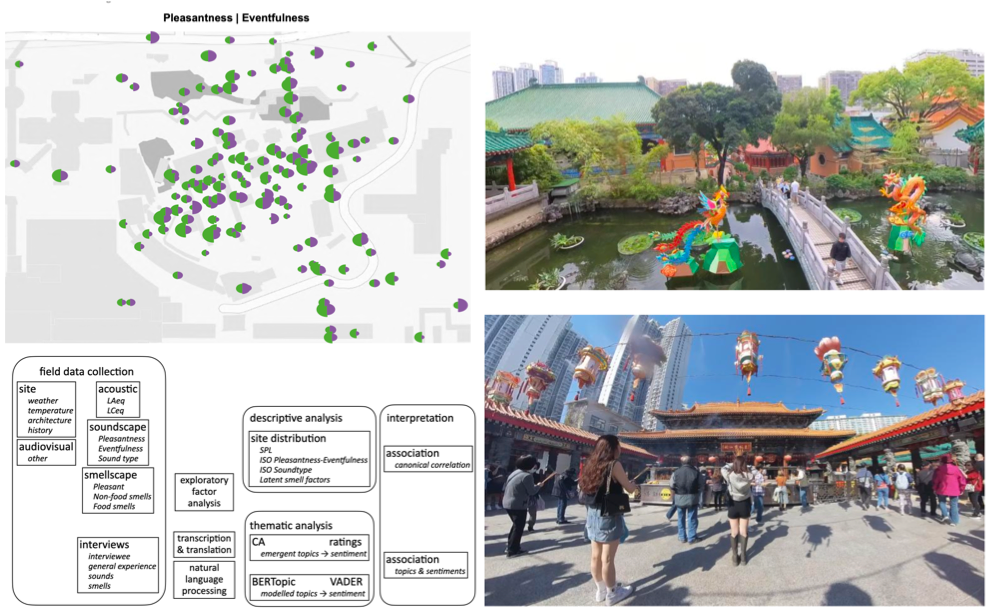
Wong Tai Sin study; Figures from Sustainability article, https://doi.org/10.3390/su17167564
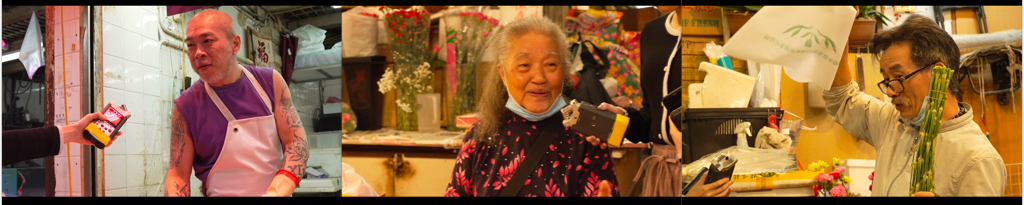
Shek Kip Mei interviews; Stills from documentary film, forthcoming.
The smellscape is the olfactory environment as perceived and understood, consisting of odours and scents from multiple smell sources. To what extent can audiovisual information evoke the smells of a real, complex, and multimodal environment? To investigate smellscape imagination, we compared results from two studies. In the first, onsite participants (N = 15) made a sensory walk through seven locations of an open- air market. In the second, online participants (N = 53) made a virtual walk through the same locations reproduced with audio and video recordings. Responses in the form of free-form verbal annotations, ratings with semantic scales, and a ‘smell wheel’, were analysed for environmental quality, smell source type and strength, and hedonic tone. The degree of association between real and imagined smellscapes was measured through canonical correlation analysis. Hedonic tone, as expressed through frequency counts of keywords in free-form annotations was significantly associated, suggesting that smell sources might generally be correctly inferred from audiovisual information, when such imagination is required. On the other hand, onsite ratings of olfactory quality were not significantly associated with online ratings of audiovisual reproductions, when participants were not specifically asked to imagine smells. We discuss findings in the light of cross-modal association, categorisation, and memory recall of smells. (Lindborg & Liew 2021)